Adjectives qualify a noun while adverbs modify verbs. In fact, the word "adverb" means "next to a verb" in latin.
Many adverbs derive from adjectives. Most of them are formed by adding the suffix -ly to the adjective. The adjectives ending in -ble just drop the final -e and add -y, while those adjectives that end in -y drop it and add -ily. Some examples are:
quick quickly
comfortable comfortably
happy happily
Exceptions:
good well
fast fast
hard hard*
*We shouldn't confuse the words hard and hardly. They are both adverbs but have different meanings: hard means rough or difficult, whereas hardly means barely or not much. Can you see the difference between "working hard" and "hardly working"?
Watch this presentation and do the exercises below:
Sunday, May 30, 2010


Saturday, May 15, 2010
Monday, May 10, 2010
Friday, May 7, 2010
Countable and uncountable nouns
Watch this presentation about countable and uncountable nouns and then do the exercises below.
Decide which nouns are countable and which nouns are uncountable
Food partitive exercises
Partitive crossword
Choose the correct partitive
A /an / some /any
Decide which nouns are countable and which nouns are uncountable
Food partitive exercises
Partitive crossword
Choose the correct partitive
A /an / some /any
Friday, April 23, 2010
Vale a pena ficar de olho nesse blog award

This blog has just received this award from one of the persons I've been following since I started blogging five months ago: Patricia Pérez Miguel, from Buenos Aires, Argentina. This means that for her, this blog is one of ten blogs worth visiting and I feel honoured! Thank you very much Patricia!
Here is my list of ten blogs worth visiting:
The English You Need Blog
Free Technology for Teachers
Larry Ferlazzo's Websites of the day
A Walk in the Words
Wordmall
Alpozo's Phonetic Blog
DCblog
Wordorigins
Mi cuaderno digital
Pasión en el hielo
Sunday, April 18, 2010
Volcanoes
A volcano of unpronounceable name, the Eyjafjallajökull, in Iceland, is causing havoc in airports in Europe and all over the world. Who doesn't know a person that has been caught in this nightmare of cancelled flights and left stranded in a foreign country, or at home deprived of the long-awaited holidays?
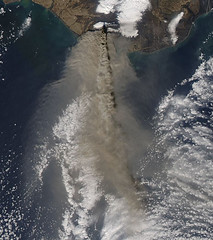
Image: 'Eruption of Eyjafjallajökull Volcano, Iceland April 17+[Detail]'
http://www.flickr.com/photos/24662369@N07/4530571303
http://www.flickr.com/photos/24662369@N07/4530571303
I have always been intrigued by volcanos. They are one of the biggest and most powerful mysteries of Nature. The old Romans believed that the god Vulcanus, son of Jupiter, had his smithy underneath Mount Etna, in Sicily. So whenever this volcano was active, they thought it was Vulcanus, the blacksmith, hitting on the iron to manufacture arms and armours for the heroes. Isn't it fantastic how mythology interprets Nature?

The Forge of Vulcan, by Diego Velázquez
In 1783, another volcano in Iceland, called Laki, produced so much poisonous gas that it killed thousands of people, and the consequences were felt not only in Iceland, but also in far away places like Egypt, where one sixth of the population died of famine caused by the low flow of the river Nile, due to the alterations of the African monsoon.
To know a bit more about the different types of volcanos watch this video and then answer the questions.
What's the weather like?
Learning weather words in English is not as easy as it seems. Because it is a recurrent conversation topic and, in great part, due to the changeable nature of the weather in Britain, the variety of weather words in English is considerable. So much so, that sometimes it's difficult to find an equivalent in Spanish.
In the following video we are going to hear some people talk about the weather. Some of the adjectives they used are written below with a translation into Spanish. The list of words is not complete, but it's a good starting point!
Temperature
hot (caluroso), warm (calentito), cool (fresco), cold (frío), chilly (fresco), crisp (frío), mild (templado).
Wind
windy (ventoso), breezy (con brisa)
Sun or absence of sun
sunny (soleado), cloudy (nublado), overcast (cubierto), dull (gris, feo), grey (gris), bright (brillante, soleado).
Rain
rainy (lluvioso), damp (húmedo), dry (seco)
In the following video we are going to hear some people talk about the weather. Some of the adjectives they used are written below with a translation into Spanish. The list of words is not complete, but it's a good starting point!
Temperature
hot (caluroso), warm (calentito), cool (fresco), cold (frío), chilly (fresco), crisp (frío), mild (templado).
Wind
windy (ventoso), breezy (con brisa)
Sun or absence of sun
sunny (soleado), cloudy (nublado), overcast (cubierto), dull (gris, feo), grey (gris), bright (brillante, soleado).
Rain
rainy (lluvioso), damp (húmedo), dry (seco)
Subscribe to:
Posts (Atom)
