Wednesday, July 28, 2010

Trip or travel?

Sometimes my students get confused when using these two words. The difference is quite simple: “travel” is mostly used as a verb, whereas “trip” is a noun. Thus, you can say: 
“I will travel to Croatia this summer.” “ I will go on a trip to Croatia this summer.”
“Travel” can also be used as an uncountable noun meaning “travelling in general”:
“People say travel broadens the mind”
“Air travel is much cheaper these days”

The plural “travels” means a long trip in which several places are visited, as in “Gulliver's Travels”, the book by Jonathan Swift in which the doctor Lemuel Gulliver embarks on several voyages that take him to faraway, exotic lands with even more exotic dwellers: Lilliput, the land of tiny people, Brobdingnag, the land of gigantic people, etc.
Another related word is “journey”, which means the movement to and from a place, whereas “trip” also implies a visit to the place you've gone to.
“I hope you have a safe journey”
“I really enjoyed my trip to Rome last year”.

Depending on the means of transport, different words can be used instead of “journey”:

  • Voyage (pronounced/'vɔɪɪdʒ/) is a long journey on a ship or boat. “The Titanic sank on its maiden voyage”

  • “Crossing” is a short journey in a boat or ship. “The ferry crossing to Ceuta took fifty minutes”.

  • “Flight” is a journey in a plane. “Our flight was delayed due to air controllers' strike”

  • “Drive” is a journey in a car. “Madrid is a five hour drive from Malaga”.

  • “Ride” is a short journey by car, bike, horse. “Let's go for a ride in my new car”
Now you can do this exercise to see how much you have learnt:

Tuesday, July 13, 2010

Waka Waka

Images in FlickrCC: http://www.flickr.com/photos/sanfora/sets/72157624133367427/ and
http://www.flickr.com/photos/36613169@N00/164281467

Well, it's over! The World Cup is over. 32 countries sent their best footballers to South Africa with just one goal in mind: to be the winners. During the five or six weeks that the competition lasts, millions of people all over the world place their expectations in a group of footballers that represent their nation. Their victories are felt like their own, and their defeat is a source of sorrow.
I'm not a football fan, but I've felt that a whole nation can vibrate and get united thanks to this sport, forgetting about the hard times we are going through, at least for a few days.
But there can only be ONE winner and this time it was Spain. In the way, so many dreams have been shattered! It's a shame there can only be one winner, because all of them deserve to hold the cup and hoist it up in the air.

The Colombian singer Shakira has sung the official World Cup song. Can you successfully complete this listening comprehension exercise?

Saturday, July 10, 2010

Clairvoyant octopus

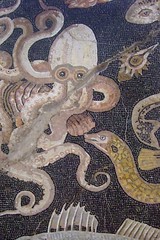
It's unbelievable! Half the world has been following the predictions of an octopus for the winners of the South Africa World Cup matches. I must admit it's the first time I hear about a gastropod that predicts the future in the way of a Roman augur or a sibyl at Delphi.

Marine life mosaic in Pompei Museo Archaeologico Nazionale di Napoli
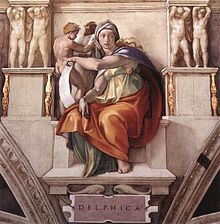
The thought of an animal willingly choosing one of two urns displaying the flag of a country seems to the modern mind just ludicrous. Yet, there is historical evidence that man has always believed that the prediction of the future is possible. Going back 2500 years, in ancient Greece, people used to travel to Delphi to consult the Oracle. It was a priestess called the Pythia or the Sibyl who, inebriated with a gas that emanated from a chasm in the rock, would say an enigma that was later “translated “ by a priest. One of the most important predictions of the Sibyl was that of Oedipus: when consulted by Laius and Jocasta, a childless royal couple, she said that they would have a son that would slain his father and marry his mother, and even though Laius tried to avoid it by getting rid of his son, we all know that the prediction came true.

Delphi Sibyl by Michelangelo in the Sixtine Chapel
Some time later, Julius Caesar would never dream of going into battle if the augurs were not favourable. By studying the flight of birds, the priests could tell if the gods were on their side or not.
In the Renaissance, Nostradamus wrote about terrible disasters and predicted the end of the world in such a vague way that one needs an interpreter to understand his prophesies, and it's only when something has actually happened when it seems clear what he meant in his verses. In this way, he is said to have even predicted the terrorist attacks on the World Trade Center. Eerie!

Nostradamus
In our days, hordes of fortune tellers, clairvoyants and horoscope readers earn a living and become rich by flattering people's ears and assuring them that they will meet the love of their lives or get a fabulous job. It's amazing how many people spend their money in this blooming industry of make believe!
In this day and age of modern, state of the art technology, an octopus is the centre of all attention because up to date it never failed a prediction. It's become so famous that it's been offered a €10000 contract to promote the delicious Galician octopus around the world and it's the king of Facebook and Twitter.
Anyway, it has chosen the Spanish flag for the Final and how I wish it doesn't fail this time!

Sunday, June 13, 2010

Few / a few, little / a little, fewer /less

Sometimes it's difficult to know when to use few or a few, little or a little. First of all, we should know that few is used with plural nouns, whereas little is used with uncountable nouns, which are always singular.
There are few apples in the basket.
We have little hope of success.
Without articles, few and little have a rather negative meaning: not much / many.
In the above examples:
There are few apples in the basket = There are not many apples
We have little hope of success= There is not much hope.
On the other hand, a few and a little (with the article) have a positive meaning: there is not much or many, but at least there is something!, which is better than nothing.
In the example:
We don´t need to go shopping: there's a little milk in the fridge and a few apples and eggs. That will do for dinner.
We can notice how the use of a before little and few gives us a positive feeling.
Fewer is the comparative form of few and less is the comparative of little.
There are fewer students in my class this year.
He earns less money than me.
However, many English speakers use less with plural  nouns, which is considered incorrect by many gammarians.
The superlative form of few is the fewest; the least is the superlative of little
This antidepressant has the fewest side effects.
Don't thank me. That's the least I could do for you.
Exercises:
Few / a few / little / a little
fewer / less, etc.

Sunday, May 30, 2010

Adverbs and adjectives

Adjectives qualify a noun while adverbs modify verbs. In fact, the word "adverb" means "next to a verb" in latin. 
Many adverbs derive from adjectives. Most of them are formed by adding the suffix -ly to the adjective. The adjectives ending in -ble just drop the final -e and add  -y, while those adjectives that end in -y drop it and add -ily. Some examples are:
quick   quickly
comfortable    comfortably
happy     happily
Exceptions:
good     well 
fast      fast
hard    hard*


*We shouldn't confuse the words hard  and hardly. They  are both adverbs but have different meanings: hard means rough or difficult, whereas hardly means barely or not much. Can you see the difference between "working hard" and "hardly working"?


Watch this presentation and do the exercises below:

Saturday, May 15, 2010

The present perfect tense

Watch this presentation and then do the exercises below:

Monday, May 10, 2010

Present perfect test

Related Posts Plugin for WordPress, Blogger...