Wednesday, May 25, 2011

Connectors showing cause and result

Connectors or linkers are words or groups of words that help us connect words, phrases or sentences. Thanks to them, we can express relationships between ideas and improve our expression by making longer, more complex sentences. For example, take these two sentences:
Our teacher was ill. We had to put off the exam.
The first sentence is the cause of the second, and the second is the result of the first. The idea would be understood more easily if we could express the relation between both sentences. Thus, we could say:
Our teacher was ill, therefore we had to put off the exam.
We had to put off the exam because our teacher was ill.
As you can see, these two examples sound better than the first two sentences, thanks to the use of the connectors therefore and because.
Image: 'The teacher'
http://www.flickr.com/photos/12836528@N00/2018663891

Connectors can be used to show contrast, purpose, sequence, etc. but today we will be concentrating on the linking words that show cause or result.

CAUSE
  • Conjunctions followed by a complete sentence:
    • Because: it usally follows the main clause: Everybody likes her because she's very kind and friendly.
    • As and since are very similar. As is less formal than since. They are used when the reason is well known. The clauses that start with these words often begin the sentence:
      As I was very tired, I went to bed early.
       Since you are not interested, I won't tell you about it.
      (As and since can also be used as time connectors).
    • For suggests that the reason is given as an afterthought. For-clauses never come at the beginning of the sentence. For is mainly used in literary texts, therefore, it is very formal.
       We listened eagerly, for he brought news of our families.
  • Connectors followed by a noun, a noun phrase, a pronoun or a gerund:
    • Because of: They have had problems raising cash because of the credit crunch.
    • Due to and owing to are considered by many speakers as exact equivalents, but this is not so, because due to is adjectival (it follows a noun or pronoun), whereas owing to is adverbial (it complements a verb). Compare these examples:
      The game was cancelled owing to torrential rain. 
      The cancellation of the game was due to torrential rain.
      If you are doubtful as to which of these you can use, here's a trick: try to substitute due to with “caused by” and see if it works. *The game was cancelled caused by torrential rain.* doesn't sound correct, so it's not possible to use due to in this case. On the other hand, The cancellation of the game was caused by torrential rain, sounds fine. 
      Owing to is interchangeable with because of: The game was cancelled because of torrential rain.
    • On account of: The nurse had to keep the baby in another room on account of my illness.
    • Thanks to suggests that there is some cause for gratitude, though it can be used sarcastically. She was given a scholarship thanks to her excellent grades.
      Image: 'Swing Chain

      http://www.flickr.com/photos/64251830@N00/385054886


RESULT or CONSEQUENCE
  • Thus (very formal): He was the eldest son, and thus, heir to the title.
  • Therefore (formal, used mainly in written English): She is only seventeen and therefore not eligible to vote.
  • As a result: There has been a rise in the number of accidents. As a result, the government has decided to lower the speed limit. As a result of is followed by a noun, pronoun or gerund. Can you rewrite the previous example using as a result of?
     As a result of the rise in the number of accidents, the government...
  • So (less formal): There was nothing on TV, so I decided to go to bed.
  • That's why: Cold temperatures kill mosquitos. That's why you won't see them in winter.
  • For this reason: The Colonel was confident that war was impending, and for this reason he hurried his preparations to leave the country.
  • Consequently (used especially in written English): This poses a threat to the food chain, and consequently to human health.

    In the following exercise you can check how much you have learnt. Good luck!

Saturday, May 14, 2011

What / how ... like?

There are several expressions that are quite similar and pose problems for learners of English because they don’t know when to use one or another. These expressions are:
  • What does she look like?
  • What is she like?
  • How does she look?
  • How is she?
We should take into account that the word like in these cases is not a verb but a preposition. When it follows the verb look, it means "to resemble" or "to be similar in appearance to".
Q: “What does she look like?” A: “She’s very pretty, with big blue eyes and blond hair”.
Image: 'Bucket-Head
http://www.flickr.com/photos/95572727@N00/2790208689

On the other hand, if you ask “how does she look?” you are inquiring about her situation at that moment, not her description. For instance, if you’ve recently visited a friend who is ill in hospital and somebody asks you “How does she look?”, you might answer “She looks better”, or “She looks pale and drawn”. They are not expecting a complete physical description but rather an account of her health. However, this question is not only used for health reasons. Another example: “How did the bride look?” “Oh, she looked absolutely gorgeous”.

When you ask the question “What is she like?” you are inquiring about somebody’s character, so you are expecting an answer that explains some characteristics of that person’s personality, such as, “She’s a wonderful person, she’s kind and generous”.

If you ask “How is she?” you are inquiring about that person’s health or state of mind. The answers you could get would be: “She’s fine”..."She´s exhausted”, …"She´s depressed”... etc.

Now you know when you can use these questions, but there is one that I’ve heard people use and doesn’t exist: *”How does she look like?”* So, forget about it!


Here is an exercise for you to check what you have learnt.


Sunday, May 1, 2011

Conditional sentences

A conditional sentence is a type of subordinate clause that states a hypothesis or condition that can be real or imagined. They are usually introduced by the conjunction if, but there are other possibilities, like unless, providing, as long as, in case (of), etc.
Wordle: if
Created with Wordle

There are four different types of conditional sentences, but some linguists consider that they can be reduced to three, since types 0 and 1 are very similar. Have a look at this table:

If clause Main clause
TYPE
0
Present simple Present simple
TYPE
1
Present simple Future

will+infinitive
TYPE
2
Past simple Conditional

would/could/might+infinitive
TYPE
3
Past perfect Perfect conditional

would/could/might+have+past participle


As you can see, in both types, 0 and 1, the subordinate clause or “if clause” has the same tense: the present simple. That's why, some grammarians consider that they are just two varieties of the same group.

In the following presentation there is a complete explanation and some examples of the different types.

When we use the verb to be in type 2 conditionals, we should use the form were for all the persons. This is so because in these sentences we have to use the subjunctive mode, which normally has the same forms as the indicative mode except for the verb to be. Therefore, this is the only verb in which we realize that the subjunctive is being used. However, many speakers tend to avoid the use of the subjunctive, which is considered very formal.
If I were rich, I would buy a Ferrari. (more formal)
If I was rich... (more colloquial)
Image: 'Ferrari F50'
http://www.flickr.com/photos/25489182@N04/4843266659


Nevertheless, were is always preferred in the expression If I were you...

There are many songs in which you can find examples of conditionals, but today we will listen to Beyoncé singing “If I were a boy”. Note the use of the contracted form of would ('d)


And now some exercises to check what you have learnt today.
Type 1 conditional
Types 1 and 2 conditionals
Type 3 conditional
Mixed types

Acknowledment: I'm very grateful to Nuria Ortiz for her wonderful exercises!

Saturday, April 23, 2011

International Book Day and St. George's Day

April 23rd was declared International Book Day by UNESCO in 1995, but it has been celebrated as such in Spain since 1923. The reason why this day was chosen to represent the book is that two of the greatest writers in the world, Cervantes and Shakespeare, died on 23rd April 1616, and in the case of Shakespeare, he was also born on that day in 1564. Isn't it a coincidence?
Shakespeare cervantes
William
Shakespeare
Miguel de
Cervantes

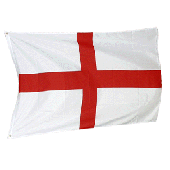
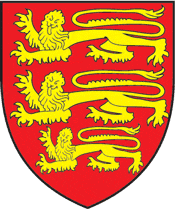
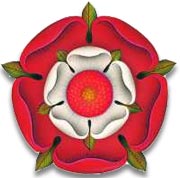
April 23rd is also St. George's Day, as this soldier saint was martyred on this day. Since the 14th century, St. George is the patron saint of England and so April 23rd is England's National Day. But don't expect parades like on St. Patrick's Day, the English don't celebrate their National Day like the Irish or the Americans. Instead, they just wear a rose, the symbol of the nation, on the button hole, at the most! Other symbols of the English nation are the flag with St. George's cross, the three lions coat of arms and the English rose, which is traditionally red.


England flag coat of arms England rose
England
flag or
St. George's flag
Coat of
arms
Tudor rose

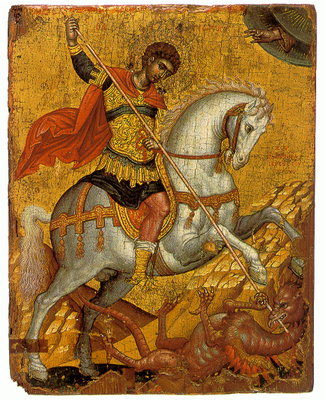
St. George is usually depicted on a horse with a spear in his hand, slaying a dragon. Legend has it that St George was travelling in Lybia when he heard that a dragon was ravaging the region. He was told that the dragon demanded a beautiful maiden as a sacrifice every day. Now it was the turn of the princess, as all the other maidens had already died. St. George fought the dragon and saved the beautiful princess. Apparently, in the place where the blood of the terrible creature had fallen, a rosebush flowered and the knight offered the lady a red rose. This is the origin of the tradition in Catalonia, Spain, where, on this day, women are given a red rose and men receive a book in return. St. George is also the patron saint of Catalonia, where he is known as “Sant Jordi”.
St George and the dragon
Icon
of St. George by Emmanuel Tzanes (1660-80), now housed in the Church of
San Salvatore, Chania, Crete.


Sant Jordi's day is really profitable for publishing companies, but you don't need to buy books, you can borrow them in the public libraries and, thanks to the initiative of a group of people from the web http://www.bookcrossing.com/ you can also find them in the streets. How is that? In this web you can register a book you want others to read. They provide you with a number that you stick on it. Then you choose a nice place where it can be found by other people. You will be able to trace where the book has been long after you have read it, and if you are lucky you can find another book, thanks to the generosity of other people.

April 23rd is the Day of the Book, but that doesn't mean that we should forget about them the rest of the year: by reading a book you can live other lives, feel what other people feel, travel all over the world. It's a fantastic and inexpensive way to experience new sensations. Try it!

Wednesday, April 20, 2011

Shade or shadow?

Foreign languages would be easier to learn if they followed the same pattern of the mother tongue: if they had exactly the same grammatical structure and the words were exact equivalents... But, unfortunately, this is just wishful thinking and things are much more difficult. Not only are there differences in grammar but also words don't describe the same realities and it's very common that you can use several words in a language and maybe just one in another to refer to the same thing. This is what makes translation a difficult job, because the translator has to take into account the context to put the same idea in the other language and try to be as accurate as possible when choosing one word or another.

Today we will have a look at two words that pose difficulty for Spanish speakers, as they are translated by the same word: “sombra”. These words are shadow and shade.

A shadow is a dark shape made when a light shines on a person or an object. It can be used with the verb to cast. As the sun was going down, the bare trees cast long shadows on the ground.

Two shadows
Image: 'wanderer'
http://www.flickr.com/photos/45409431@N00/5363175420

A shade is a cool dark area under or behind a tree, a building, etc. that is protected from the heat of the sun. The adjective shady can be used for these areas. We had some drinks in the cool, shady garden.
A rocking chair in the shade
Image: 'Porch Rocker'
http://www.flickr.com/photos/36783643@N05/3409619940

When shadow is used as an uncountable noun or in the plural (the shadows) it means “darkness”. I couldn't see her very well as her face was in shadow.

Shadow can be used as a verb to mean “to follow someone closely and secretly”. And it can also be used as an adjective when referring to politicians of the opposition party that would be ministers if they won the election. Nine previous members of the shadow cabinet have not made it to the new cabinet.

If somebody has shadows under the eyes, they have dark areas under the eyes because they are tired. But if they use eye shadow, they are using make-up on their eyelids.

Apart from that first meaning, shade is also the part of lamp that makes its light less bright.
Lampshade
mage: 'Night lamp with handmade paper shade'
http://www.flickr.com/photos/63465428@N00/4130978646

Shade can also be used with colours to say how dark or light they are. She was wearing a pleasant pastel shade of blue.
Shades of green
Image: 'Into the Green at Hidcote Manor Garden'
http://www.flickr.com/photos/8525214@N06/3222505862

When used in the plural, shades can mean “sunglasses”.

Idioms:
  • If you are scared of your own shadow, you are easily frightened.
  • To put somebody or something in the shade means to be much better than that person or thing. I thought I had done well in the exams, but John's results put mine in the shade.
Now you can check how much you have learnt with this exercise:

Wednesday, April 13, 2011

Easter traditions

In many countries, when children think of Easter, they think of eggs, rabbits and chicks. But what do these have to do with the Passion of Jesus Christ? Well, nothing at all. The rabbits and the eggs, though associated with the Christian tradition, are actually of pagan origin. In fact, the name “Easter” comes from a pagan goddess, Eostra, who was a deity related to spring and fertility. Her symbol was the hare or rabbit, and this is where the association of Easter and the rabbit begins. Apparently, it was the German immigrants who took the tradition of the egg-laying rabbit to America, being the egg a symbol of the new life that spring brings about.
Easter cupcakes
Image: 'For Foodwhirl.com - Easter Cupcake inspirations'
http://www.flickr.com/photos/41214178@N00/4458291705

The first Sunday of the Holy Week is called Palm Sunday because it was on this day that Jesus entered Jerusalem and was greeted by people carrying palms and olive branches, and it is on the last Sunday, which is called Easter Sunday, that the Christians celebrate the Resurrection of Jesus Christ, and is the day when most traditions take place. One of these is egg-hunting. Legend has it that the Easter rabbit hides painted or dyed eggs all over the garden, and children must try to find them all. Nowadays, Easter eggs are made of chocolate, and children are also given jelly beans, chocolate bunnies and eggs full of surprises inside.
Jelly beans
Image: 'I have discovered an entire new food+group'
http://www.flickr.com/photos/66656285@N00/2475639269
Egg rolling takes place on Easter Monday. In many parts of the UK children roll hard-boiled eggs down a hill, and the winner is the one that takes the egg the farthest or the one whose egg survives! In the USA, the President and First Lady sponsor an egg rolling competition on the grounds of the White House, where children of up to 12 years old take part. This is the only occasion in which tourists are allowed to tread over the White House lawn!
Easter eggs
Image: 'Eastereggs'
http://www.flickr.com/photos/8331463@N07/2370157845

Apart from chocolate eggs, people traditionally eat Easter cakes and hot cross buns, which are eaten on Good Friday, the day when Christians celebrate the death of Jesus Christ, and that's why these buns have a white cross on top. There is a famous nursery rhyme that goes:
Hot cross buns,
Hot cross buns,
One a penny,
two a penny
Hot cross buns.
If you have no daughters,
give them to your sons.
Hot cross buns.


A much funnier Easter song is this bunny rap.


If you want to learn more about the history of Easter, I wrote an entry in this blog last year about it.


To see how much you have learnt, try this reading comprehension test:


Friday, April 8, 2011

Wet, damp, moist and other words of the same semantic field

Wet, damp, moist,...Which of these words would you use to describe something that has got water or another liquid on its surface? They are not exact equivalents, and sometimes it's difficult for learners of English to spot the difference in nuance. We are going to see their meanings and we'll also add some other words of the same semantic field.


Adjectives:
  • Wet is used when something is full of water. You can use it with intensifiers like soaking or dripping.      He was walking under the rain and by the time he got home his clothes were soaking wet.
  • Soaked means very wet. It is usually used for clothes. If they are extremely wet, we would say soaked through. When they finally stopped, the storm having passed, they were soaked through and chilled to the bone.

Soaking wet / drenched
mage: 'Cleo being soaked'
http://www.flickr.com/photos/71753457@N00/48635289

  • Soggy is used for paper, food or similar that have become soft because they are wet. It can also be used for clothes or for bad, wet weather. It was so damp in that old house that the bread and biscuits became soggy in minutes.
  • Waterlogged is used for ground that has so much water on the surface that it cannot hold any more. The river burst its banks and all the fields were waterlogged.
  • Damp is slightly wet, but in an umpleasant way. We stayed at a horrible hotel. It was cold and damp.
  • Moist is also slightly wet, but generally not in an unpleasant way. If something is moist, it is neither too dry nor too wet. It can be used for the skin and even for cakes. Doctors advise that a child's skin should be kept moist with softening lotions.
          This cake is delicious. It´s so moist!

Moisture on a rose
Image: 'Pink rose'
http://www.flickr.com/photos/60364452@N00/565893224

  • Humid is used to describe the weather. It means wet and hot, containing a great deal of water vapour. This plant thrives in humid places like the Amazon Rainforest.
Verbs:
  • To wet or to get wet
  • To soak is to make someone or something very wet. Figuratively it is used to mean “to be immersed in something”, even if it's not a liquid. He is extremely wealthy. In fact, he is soaked in riches.
  • To drench is to make someone or something extremely wet with a lot of water. The passing car drenched me as it drove through a puddle.
  • To flood is to cover an area of land with a great amount of water. Hurricane Katrina flooded a great part of New Orleans.
  • To dampen or damp is to make something slightly wet. You should dampen the soil before sowing the seeds.
  • To moisten is to put a few drops of liquid onto something. Add enough water to moisten the cake mixture.
Some idioms:
  • Wet behind the ears: inexperienced.
  • A wet blanket: someone who spoils a happy event, also called killjoy or spoilsport
  • If you wet your whistle you have an alcoholic drink.
To sum up:

VERB ADJECTIVE NOUN
extremely soak soaked/soaking
drench drenched
flood flooded flood /
flooding
very wet / get
wet
wet wetness
slightly dampen /
damp
damp dampness
moisten moist moisture

Try this exercise to check what you have learnt.
Related Posts Plugin for WordPress, Blogger...