Recently, I commented with my students on the news that Scotland is to hold a referendum to regain independence, and I was surprised to see how confused they were about the fact that Scotland is a nation that forms part of a bigger country: the United Kingdom. In fact, the correct name of the country is “The United Kingdom of Great Britain and Northern Ireland”, and it is formed by four nations: England, Scotland, Wales and Northern Ireland.
The United Kingdom of Great Britain and Northern Ireland Image
Great Britain is the name of the biggest island in the archipelago of the British Isles, formed also by Ireland and many other smaller isles.
Great Britain is divided into three nations: England, Scotland and Wales.
England is the largest territory and the most populated in the country. It’s capital is London and people there speak English. The National Day is St. George’s Day (April 23rd).
England flag
Coat of arms
Emblem: England rose
Scotland lies to the north of England, and is part of the United Kingdom since the Acts of Union of 1707. It is not so densely populated as England. It’s capital is Edinburgh. The official language is English, but most people also speak Scots, which is a language derived from English, and only 1.5 % of the population speak Scottish Gaelic, which is a Celtic language. The National Day is St. Andrew’s day (November 30th)
Scotland flag
Coat of arms
Emblem: Thistle
Wales lies to the west of England. It was conquered by king Edward I of England in the 13th century. It’s capital is Cardiff. The Welsh speak English and Welsh, which is a Celtic language. The National Day is St. David’s Day (March 1st).
Wales flag
Coat of arms
Emblems: leek and daffodil
The second biggest island, Ireland, is divided in two:
The Republic of Ireland or Eire, which is an independent country since 1922, so it is not part of the United Kingdom. Its capital is Dublin, and people speak English and Irish, which is a Celtic language.
Northern Ireland or Ulster is the smaller territory that lies in the northeast of the island of Ireland. Its capital is Belfast and people speak English and Irish. The National Day is St. Patrick’s Day (March, 17th)
St. Patrick's flag (Northern Ireland)
Republic of Irleand flag
Emblem: shamrock
We have seen the flags of all the territories that conform the United Kingdom, but as a country, it also has a flag: the Union Jack, which is formed by the union of the flags of England, Scotland and Ireland, as you can see in the following video.
The Welsh flag is not included in the Union Jack because Wales was part of England long before the United Kingdom was born. This is explained in this video by C.G.P. Grey. Even though he speaks too quickly forstudents of Englishto understand, I hope the subtitles can be helpful.
Teachers of English may be interested in this webquest by Joao Jardim Fernandes.
Finally, let’s check how much we have learnt about the UK today with the following test. By the way, the acronym UK stands for United Kingdom.
In the last blog post I wrote about Homes under the Hammer, a BBC programme I am very keen on. We watched a part of an episode in which a tired, drab Victorian terraced house had been bought at auction by a young couple. Unfortunately, it was too long to watch in just one session. Now we can see what happened with that Victorian house. Would you like to see the transformation? Let’s watch it! But first, here is the basic vocabulary that will help you understand the video:
Beset by problems: with lots of problems.
Bay fronted: having a bay window at the front.(see picture)
Terraced house: a house that shares sidewalls with adjacent houses. (See Types of dwellings)
Many features still intact: many of the original characteristics of the house can still be found.
Auction lot: an item or set of items for sale at an auction.
Crisp and clean: immaculate
Ironwork: objects made of iron, such as railings.
Reception rooms: rooms for receiving and entertaining visitors.
Lounge-dining area: a room that can be used both as a living room and a dining room
Stunning: impressive, very attractive
Open plan kitchen: a kitchen that is open to the dining room (see picture)
Glass box extension: an extension made entirely of glass. (see picture)
One of the programmes on British television I love watching is Homes under the Hammer. It’s about the sale at auction of houses, most of which are in a really bad state (almost derelict some of them) and how the new owners turn them out to look nice and cozy after a few months’ work. Once the house is finished, the programme invites a couple of estate agents to assess how much the property may be worth now if put to the market, or how much money they may expect to earn if rented. It goes without saying that the result of the improvements is such that the value of the houses usually increase, even if we deduct the purchasing price and the expenses incurred by the new owners. I love seeing the difference between the “before” and the “after”.
Lucy Alexander and Martin Roberts are the presenters of "Homes under the Hammer
Image from the BBC
In every programme we get to see three different properties, but that takes one hour. Therefore, we will watch just a part of one of the programmes in two videos. However, as they take twenty minutes in total, we will divide it in two blog posts so that it doesn’t get too long. I hope you enjoy Homes under the Hammer as much as I do!
Before watching the video, let’s have a look at the meaning of some of the words and expressions that we will hear.
A Period house is a house that was built during a certain historical period. It can be Victorian, Georgian, Edwardian... (see explanation in a previous post)
Brimming with period features / period features galore: filled with the characteristic elements of the houses of that historical period.
Townhouse: terrace house, row house
Quid is another word for pound. It comes from the Latin expression “Quid pro quo”, which means "this for that".
The guide price is the price that the property is expected to sell for.
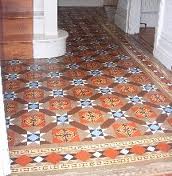
Minton tiles (See picture)
Ceiling rose (See picture)
Cornicing or cornice is the ornamental moulding along a wall. (See picture)
Master bedroom is the main bedroom in the house
Sash window: a window with two sliding panels. (See picture)
Refurbish: to renovate, to make clean or fresh again.
Converting the attic space: making the loft or attic a liveable place.
Loft extension: loft conversion
Side extension: If you build a side extension, you make the house bigger by adding extra room at the side.
Nooks and crannies: corners.
Basement: the lowest story in a building, usually below ground level.
Oodles: lots, a large quantity.
Potential. If a house has potential, it has the necessary qualities to become a great house in the future.
En suite. An en suite bathroom is next to a bedroom and can only be reached by a door in the bedroom. It’s a French expresion that means “part of a set”.
On the rental market. If something is on the rental market, it is up for rent.
A sell on valuation. If you buy a house and then sell it off, you sell it soon after buying it in order to make a profit. The valuation is the price that it is expected to reach.
The winning bidder is the person that bids the highest price at the auction and so gets the house or any other object that is being auctioned.
The successful bid is the offer that gets the object that is being sold at auction.
Thrilled to bits: extremely excited or delighted.
It ticks most of the boxes: it has most of the features that we were looking for.
The Common: A tract of land, usually in a centrally located spot, belonging to or used by a community as a whole.
A bone of contention is something on which it is difficult to reach an agreement.
The budget is the amount of money you have available to spend.
I reckon: I think
knock through: break down
And now let’s watch the video about a lovely Victorian house in Balham, London.
A collocation is a combination of words that occurs frequently enough to be recognized as a common combination. When learning a foreign language, it’s really useful to learn collocations instead of single words, because they are much easier to remember and, by using them, you will sound more natural and people will understand you more clearly.
In a previous post we saw the collocations with do and make. Today we are going to see when to use have or take. The difference here is not so straightforward, because sometimes both verbs can be used and, in other cases, Americans use take while British people use have with the same meaning.
Have can be used with object nouns to refer to a number of different activities. In these cases, the verb has little or no meaning by itself, that’s why it is known as a “delexical verb”. In American English take is used instead of have when referring to common activities such as washing, resting, eating or drinking:
Have/take a holiday/vacation, a rest, a nap,
have / take a shower, a bath...
Have/take a meal, breakfast, lunch, dinner, a drink...
Sometimes both verbs can be found with no change of meaning on both sides of the Atlantic:
Have/ take a break
have/ take a bite (eat something)
Apart from these cases, have and take can be found in the next collocations:
Have
Take
a good time, fun, a laugh, a party
care (of)
a talk, a chat, a conversation, a word with
a decision
a baby (give birth)
exercise
a problem, difficulty in, trouble
notes
a relationship
a taxi, a cab, a train, a bus...
an excuse
a look
a grudge against someone
an exam
work
a photo, a picture
a (nervous) breakdown
a risk
a headache, toothache...
an interest in
cover
In all these cases have is not an auxiliary verb, so we need do /does /did for questions and the negative. Besides, it is never used with got, and it cannot be contracted (‘ve / ‘s). * We hadn’t lunch yesterday. We didn’t have lunch yesterday. *I have got a talk with my brother about that issue. I have had a talk with my brother about that issue. *I’ve dinner at home every day. I have dinner at home every day. On the other hand, it can be found in any tense, even the progressive or continuous tenses. She is having a baby next month.(present continuous)
The difference between these two nouns is not always clear.
A house is a type of building where someone lives. It is intended to be used by just one family and it may have more than one floor. Home is the place where someone lives and feels that they belong to. Your home can be a house, an apartment or a farm, but if you live there, that’s your home. However, you can also find the term home with the meaning of “building” when you think of it as a property that can be bought or sold. They are building a lot of new homes next to the railway station. You can also use the term home when you mean your town or country. After living abroad for many years, I long to go back home to Spain.
A dwelling is any place (house, flat, …) where a person lives. It refers to the actual building. The development will consist of 60 dwellings and a number of offices and commercial premises. Abode is a formal word to say dwelling. Welcome to my humble abode.
Homework and housework are also different. The former means the school tasks that you have to do at home, while the latter means the work that you do to take care of your home, such as cleaning, washing, etc. Please, note that both these words are uncountable. The children were doing their homework on the dining table while their parents were doing the housework.
Other related words are:
Homesick: you feel homesick when you are away from home and really miss your family and friends. Exchange students usually feel homesick.
Homeless: people are homeless if they don’t have a home.
House-proud: someone is house-proud if they spend a lot of time making the house look clean and attractive. Her husband does the cleaning, washing and shopping. He’s very house-proud.
Idioms:
At home. If you feel at home with something, you feel quite comfortable with it. He feels at home with his new job.
To set up home is to start to live in a house. After living for several years in new York, he has decided to set up home in Toronto.
If drinks are on the house you do not have to pay for them, as they are provided free by the owner of the bar. Let’s go to that new pub, the first drink is on the house tonight.
If two people get on / along like a house on fire, they become friends very quickly.
If you work from home, you do not work in an office. Today, more and more people are working from home thanks to the internet.
Note that the preposition to is not used before home. I’m going home. When there is no idea of movement, at is used in British English, while Americans don’t use any preposition at all. He usually stays at home at the weekend. <British> He usually stays home on the weekend. <American>
In the following presentation you can see different types of dwelling, especially those that you can find in Great Britain.
Now you can do the following crossword to check what you have learnt.


.jpg)


.jpg)