 |
| Cheetahs run very quickly Image |
Today we are going to have a look at the affixes (suffixes or prefixes) that create adverbs.
The most productive suffix for adverbs is -ly, but there are others: -wards, -wise and -ways. Besides, there are also adverbs starting with the prefix: a- :
-ly
-ly is added to adjectives to create adverbs. Most adverbs just take ly, but there are certain spelling rules:
- The -y ending after a consonant usually changes to i before the suffix: happy--> happily, easy-- easily. Exceptions are one-syllabled: shy--> shyly, sly-->slyly. Dry can have two spellings: dryly and drily.
- The adjectives true, due and whole drop the final e: truly, duly, wholly.
- Adjectives ending in -ple, -ble, -dle, -tle drop the silent e and take a y: simple--> simply, probable--> probably, idle--> idly, gentle--> gently.
- Adjectives ending in -ic add -al before -ly: fantastic--> fantastically. Exception: public--> publicly.
- Adjectives already ending in -ly such as lovely, friendly, silly, lively, jolly, heavenly, leisurely... do not take the -ly sufix. In fact, they do not change into adverbs, but an adverbial phrase is used instead: He greeted me in a friendly manner. He is behaving in a silly way.
 |
| Adverb Wordle Image |
Same form as adjectives
- Some adjectives are used as adverbs with no change of spelling: fast, straight, hard...: That´s a fast car (adjective). He drives very fast (adverb). It's hard work (adjective). He works hard (adverb).
- Some adjectives ending in -ly that are related to time are also used as adverbs: weekly, hourly, daily, monthly... remain unchanged: A daily newspaper (adjective) He comes here daily (adverb).
- A few adjectives ending in -ly remain the same as adverbs: deathly, only, bodily, masterly. He is an only child (adjective). I've seen him only once (adverb).
-wards or -ward
- This suffix can end in s or not. Generally, -wards is used in British English, while -ward is preferred in America. However, some of these words ending in this suffix can also act like adjectives, in which case, they always end in -ward: Let's go forward(s) (adverb). The forward movement of History (adjective). When forward is used in phrasal verbs, it never ends in s: I look forward to hearing from you. The meeting has been brought forward to this Friday.
- -wards is usually added to prepositions or nouns to give the idea of direction: upwards, downwards, forwards, backwards, inwards, onwards, outwards, eastwards,southwards, seawards... The back garden faces seawards so you can always have a pleasant view.
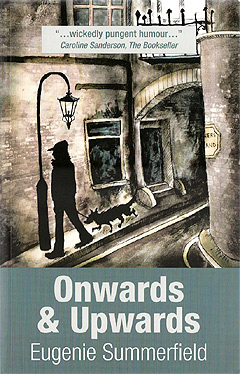 |
| Onwards and upwards by Eugene Summerfield Image |
-wise
- The suffix -wise is usually added to nouns to form adverbs and adjectives. It gives the meaning of "in the manner of" or "in the direction of": clockwise, anticlockwise = counterclockwise, likewise, lengthwise, crabwise, contrariwise, otherwise,... It can also mean "concerning": Things aren't too good businesswise (i.e. concerning the business)
-ways
- This suffix also means "in the direction of": edgeways, sideways, lengthways, breadthways... Do not confuse it with the compounds of the noun way (meaning "road"), such as carriageway, causeway, highway, railway... When in doubt, bear in mind that such compounds can be used in the singular as well as the plural, whereas the adverbs always end in s.
a-
- We shouldn't confuse this prefix with the prefix a- of Greek origin that means "not", as in apolitical, amoral, asexual.... In this case, the prefix a- which forms adverbs comes from Old or Middle English and is no longer productive, so no more words are being created with it. Usually added to addjectives or nouns, it gives the meaning of location: "on", "in"; afoot, abed, abroad, along, aloud, around, ahead... Sometimes it means "of": anew, akin.
Compound adverbs
There are quite a few adverbs that are formed by combining here, there and where with various prepositions, all of which are old-fashioned and mainly used in formal language. Here are some of them:
Exercises:
There are quite a few adverbs that are formed by combining here, there and where with various prepositions, all of which are old-fashioned and mainly used in formal language. Here are some of them:
- Here- compounds: hereabout, hereafter, hereby, herein, hreof, hereto, herewith, etc.
- There- compounds: thereabout, thereafter, thereby, therefrom, therein, thereupon, therefore, etc. The latter is the only one of these which is still widely used.
- Where- compounds: whereat, whereby, wherefore, whereof, whereon, whereupon, wherewith, etc.
Exercises:
For more information on adverbs and their position in the sentence, visit Lola Dominguez's blog.
The logical song by Supertramp is full of adjectives, but among them are a few adverbs. Can you spot them?
The logical song by Supertramp is full of adjectives, but among them are a few adverbs. Can you spot them?


