Watch this presentation about countable and uncountable nouns and then do the exercises below.
Decide which nouns are countable and which nouns are uncountable
Food partitive exercises
Partitive crossword
Choose the correct partitive
A /an / some /any
Friday, May 7, 2010


Friday, April 23, 2010
Vale a pena ficar de olho nesse blog award

This blog has just received this award from one of the persons I've been following since I started blogging five months ago: Patricia Pérez Miguel, from Buenos Aires, Argentina. This means that for her, this blog is one of ten blogs worth visiting and I feel honoured! Thank you very much Patricia!
Here is my list of ten blogs worth visiting:
The English You Need Blog
Free Technology for Teachers
Larry Ferlazzo's Websites of the day
A Walk in the Words
Wordmall
Alpozo's Phonetic Blog
DCblog
Wordorigins
Mi cuaderno digital
Pasión en el hielo
Sunday, April 18, 2010
Volcanoes
A volcano of unpronounceable name, the Eyjafjallajökull, in Iceland, is causing havoc in airports in Europe and all over the world. Who doesn't know a person that has been caught in this nightmare of cancelled flights and left stranded in a foreign country, or at home deprived of the long-awaited holidays?
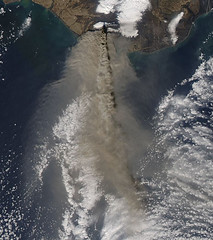
Image: 'Eruption of Eyjafjallajökull Volcano, Iceland April 17+[Detail]'
http://www.flickr.com/photos/24662369@N07/4530571303
http://www.flickr.com/photos/24662369@N07/4530571303
I have always been intrigued by volcanos. They are one of the biggest and most powerful mysteries of Nature. The old Romans believed that the god Vulcanus, son of Jupiter, had his smithy underneath Mount Etna, in Sicily. So whenever this volcano was active, they thought it was Vulcanus, the blacksmith, hitting on the iron to manufacture arms and armours for the heroes. Isn't it fantastic how mythology interprets Nature?

The Forge of Vulcan, by Diego Velázquez
In 1783, another volcano in Iceland, called Laki, produced so much poisonous gas that it killed thousands of people, and the consequences were felt not only in Iceland, but also in far away places like Egypt, where one sixth of the population died of famine caused by the low flow of the river Nile, due to the alterations of the African monsoon.
To know a bit more about the different types of volcanos watch this video and then answer the questions.
What's the weather like?
Learning weather words in English is not as easy as it seems. Because it is a recurrent conversation topic and, in great part, due to the changeable nature of the weather in Britain, the variety of weather words in English is considerable. So much so, that sometimes it's difficult to find an equivalent in Spanish.
In the following video we are going to hear some people talk about the weather. Some of the adjectives they used are written below with a translation into Spanish. The list of words is not complete, but it's a good starting point!
Temperature
hot (caluroso), warm (calentito), cool (fresco), cold (frío), chilly (fresco), crisp (frío), mild (templado).
Wind
windy (ventoso), breezy (con brisa)
Sun or absence of sun
sunny (soleado), cloudy (nublado), overcast (cubierto), dull (gris, feo), grey (gris), bright (brillante, soleado).
Rain
rainy (lluvioso), damp (húmedo), dry (seco)
In the following video we are going to hear some people talk about the weather. Some of the adjectives they used are written below with a translation into Spanish. The list of words is not complete, but it's a good starting point!
Temperature
hot (caluroso), warm (calentito), cool (fresco), cold (frío), chilly (fresco), crisp (frío), mild (templado).
Wind
windy (ventoso), breezy (con brisa)
Sun or absence of sun
sunny (soleado), cloudy (nublado), overcast (cubierto), dull (gris, feo), grey (gris), bright (brillante, soleado).
Rain
rainy (lluvioso), damp (húmedo), dry (seco)
Sunday, April 11, 2010
Ten horse idioms
From Queen Boudicca to the races in Ascot, the horse has always been part of life in Britain. The Celts, who arrived in Britain around 500 BC, worshiped horses and carved them on chalk hills in southern England. It is not known how many of them have been lost through the years but it is believed that there were hundreds of them.

Now you can try this exercise to check what you have learned.
In this exercise there are mixed animals idioms.
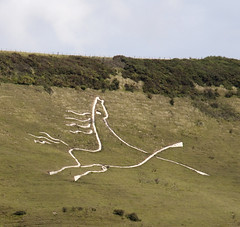
http://www.flickr.com/photos/37804979@N00/3828029816
The white horse and the horseshoe are said to bring good luck. It is still common for the bride and groom to receive a lucky horseshoe at weddings.
.jpg)
Being so important culturally, it is not strange that many English words and phrases derive from the horse. Today we will be having a look at ten idioms that use the word horse. In brackets, a translation to Spanish. But I'd be delighted if you could suggest better translations!
- You can lead a horse to water, but you can't make it drink = you can give someone the opportunity to do something but you cannot force him or her to do it if they do not want to.
- To bet on the wrong horse = to support someone or something that cannot win or succeed.
- To change horses in midstream = to make new plans in an activity that has already begun. (no cambiar de caballo a mitad del río).
- To hold one's horses = to be patient. (Tranquilo, ve con calma)
- To lock the barn door after the horse is gone = it's too late now. (A buenas horas mangas verdes)
- To eat like a horse = to eat a lot. (Comer como una vaca)
- Straight from the horse's mouth = directly from a dependable source. (de fuente fidedigna)
- To flog a dead horse = It's useless now. (hacer un esfuerzo inutil)
- To look a gift horse in the mouth = to complain if a gift is not perfect. (A caballo regalado no le mires el diente)
- To put the cart before the horse = to do things in the wrong order. (Empezar la casa por el tejado)
In this video you can get further explanations about some of the idioms above. After watching it you can do the exercises to check how much you have learnt.
Now you can try this exercise to check what you have learned.
In this exercise there are mixed animals idioms.
Tuesday, April 6, 2010
Saturday, April 3, 2010
Subscribe to:
Posts (Atom)
